09 March 2008

The Intelligentsia and the Revolution - Aleksandr Blok

While known mostly for his (admittedly brilliant) poetry, Aleksandr Blok was also a profound essayist. If you thought Hemingway captured the ennui and detachment of the Great War, just you wait 'n see.
"What is the war like? Bogs, bogs, and bogs, overgrown with grass or covered with snowdrifts; in the west, a dreary German searchlight- groping- night after night. On a sunny day a German Fokker appears; it doggedly flies along one and the same path, as if a path could be worn and befouled even in the sky. Little puffs of smoke spread out around it, white, gray, reddish (that's us shooting at it, hardly ever hitting; like the Germans- at us). The Fokker is flustered, falters, but tries to stay on its foul little path; sometimes it methodically drops a bomb. This means that the spot it aims at has been punctured on the map by dozens of German staff officers. The bomb falls, now on a graveyard, now on a herd of cattle, now on a herd of people, but more often, of course, into a bog; that's thousands of people's rubles in a bog."
Jeez. Someone's a Debbie Downer.
"Europe has gone insane. The flower of manhood, the flower of the intelligentsia, sits for years in a bog, sits with conscious determination (isn't that symbolic?) on a narrow strip a thousand versts long, which is called 'the front.'"
I think now's a good time to mention that the Russian word for God is Бог, pronounced "bog".
"What has a people or a man to live for who... thinks that being alive 'isn't too bad but not very pleasant either,' because 'everything goes its ordained way'- the way of evolution- and that people, generally speaking, are so shoddy and imperfect that the best they can expect, God willing, is to blunder through their life span somehow, knocking together societies and states, blocking themselves off from one another with little walls of rights and obligations, conventional laws, conventional relationships."
Blok's alternate title for this piece was "Why Tristyn Bloom Should End Her Sorry Existence."
"Could even a grain of the truly precious be lost? We have loved too little if we fear for the things we love. ... A palace that is being destroyed is no palace."
Circular logic, or inspiring call to revolution? Early 20th century Russians can't tell the difference.
"The ground under the bourgeois' feet is as concrete as the muck under the hog's: family, money, position, medal, rank, God on his ikon, the Tsar on his throne. ... The intelligent has always boasted that he never had that kind of ground to stand on. ... Skill, knowledge, methods, habits, talents are nomadic, winged possessions. We are homeless, familyless, rankless, poor- what have we to lose?"
What have you to fight for?
"Proud politicking is a great sin. The longer the intelligentsia remain aloof and sarcastic, the more terror and bloodshed there will be. Dreadful and dangerous is that elastic, dry, unsavory "adogmatic dogmatics" seasoned with patronizing soulfulness. Behind the soulfulness is blood. The soul attracts blood. Only the spirit can combat horror. Why bar with soulfulness the way to spirituality? The good is hard as it is."
I have a feeling that if I wrote a script to randomly generate early Russian revolutionary tracts, the result would come out something like this.

06 March 2008

Unit 11, Live from Moscow

Been studying for my Russian exam (which is tomorrow); ignoring the damning specter of my neurolinguistics exam (six hours from now). Also think I had a Roman history writing assignment due yesterday... When Yale tells you they don't make admissions mistakes, they're wrong.

All taken exactly from my Russian textbook:
"Можно мне курить здесь?"
May I smoke here?
"В этой комнате нельзя мне работать!"
In this room, it is impossible for me to work!
"Разве это жизнь?"
Is this really a life?

Good question.


04 March 2008

Mother of Men - Brian Hooker

Lots on my mind lately... went thumbing through my copy of Songs of Yale, bequeathed to me by that other highly traditional group of which I'm a member (147 years and counting).

We don't sing this song anymore... symptom of a much larger problem, methinks.

"Mother of Men, grown strong in giving
Honor to them thy lights have led;
Rich in the toil of thousands living,
Proud of the deeds of thousands dead.

We who have felt thy pow'r and known thee,
We in whose work thy gifts avail,
High in our hearts, enshrined, enthrone thee,
Mother of Men, Old Yale.

Spirit of Youth, alive, unchanging,
Under whose feet the years are cast,
Heir to an ageless empire, ranging
Over the future and the past;

Thee, whom our fathers loved before us,
Thee, whom our sons unborn shall hail,
Praise we today in sturdy chorus,
Mother of Men, Old Yale."

28 February 2008

The Martyrdom of Saints Perpetua and Felicitas

"For these too will one day become ancient and needful for the ages to come, even though in our own day they may enjoy less prestige because of the prior claim of antiquity."
This was written around AD 203, roughly.
"Thus no one of weak or superficial faith may think that supernatural grace was present only among men of ancient times, either in the grace of martyrdom or of visions, for God always achieves what he promises, as a witness to the non-believer and a blessing to the faithful."
Trads beware.
"She had been pregnant when she was arrested, and was now in her eighth month. As the day of the spectacle drew near she was very distressed that her martyrdom would be postponed because of her pregnancy; for it is against the law for women with child to be executed. ... And so, two days before the contest, they [the Christians in prison with her] poured forth a prayer to the Lord in one torrent of common grief. And immediately after their prayer the birth pains came upon her. ... And she gave birth to a girl."
Is that the right attitude to have towards martyrdom? Or motherhood? Or anything?
"For whenever they would discuss among themselves their desire for martyrdom, Saturninus indeed insisted that he wanted to be exposed to all the different beasts, that his crown might be all the more glorious."
Can a Catholic please explain this to me? This seems fundamentally wrong, or at least, like... impious.
"For the young women, however, the Devil had prepared a mad heifer. This was an unusual animal, but it was chosen that their sex might be matched with that of the beast. So they were stripped naked, placed in nets and thus brought out into the arena. Even the crowd was horrified when they saw that one was a delicate young girl and teh other was a woman fresh from childbirth with the milk still dripping from her breasts. And so they were brought back again and dressed in unbelted tunics."
What were they thinking, sending them to face the beast without their tunics! Gosh, how uncultured.
"First the heifer tossed Perpetua and she fell on her back. Then sitting up she pulled down the tunic that was ripped along the side so that it covered her thighs, thinking more of her modesty than of her pain. Next she asked for a pin to fasten her untidy hair: for it was not right that a martyr should die with her hair in disorder, lest she might seem to be mourning in her hour of triumph."
This is starting to sound like something out of a Mel Brooks movie.

26 February 2008

Life of Our Blessed Father Theodosius

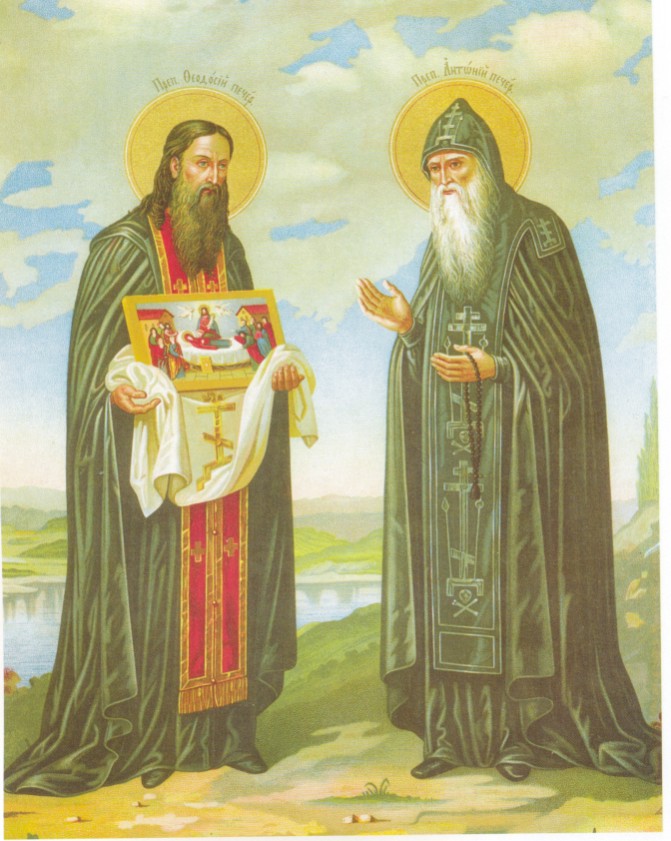
I love all of the Russian Saints' Lives, but this one is particularly dear to me. I'm going to make a pilgrimage to the Monastery of the Caves (Киево-Печерская лавра) one day.
"He did not draw near to the children playing, as is the custom of youth, but disdained their games. His clothing was poor and patched. For this reason his parents many times tried to force him to dress in clean clothing and to go out and play with the children; but he did not obey them in this, but willed even more to be like one of the poor."
oh-em-gee he recognizes that the judgment of his parents is fallible no waiiii.
"Thenceforth he began to be more persevering in his works, as when he would go away with the serfs to the country and act with all manner of humility. But his mother would hinder him, not wishing him to do such things..."
Wait what? His mother doesn't have his best interest in mind?
"She would often get angry at him and beat him; for she was strong and solid in body as a man, and, indeed, if someone could not see her but only hear her conversing, he would begin to think she was a man."
Slavic women for the win.
"Having gotten up during the night and not letting anyone know, secretly went out of the house, not taking with him anything except the clothing he was wearing, and even that was poor. And in that manner he went away behind the pilgrims. ... After three days his mother, having found out... rode hurriedly a long way, and, catching up with them, took Theodosius. And from rage and anger his mother grasped him by the hair and threw him upon the ground and kicked him with her feet. And, having severely reproached the pilgrims, she returned home leading her son tied like a villain."
A few months prior to this his father died. See what happens in the absence of a strong father figure?
"Being gripped by such great anger, even when they had arrived home, she beat him until she could no longer. And after this she led him to a room, tied him up, and locked the door as she left. The divine youth, however, accepted all these things with joy, and praying to God, gave thanks."
He's thirteen here, by the way.
"She... began with entreaty to persuade him not to run away from her, for she loved him very much more than her other children and for this reason could not bear living without him. And when he promised that he would not leave her, she removed the irons from his legs."
Love. Right.
"Having again seen him baking sacramental wafers and becoming blackened from the fire in the oven, she deplored it greatly. And from that time she began again to scold him, sometimes with caresses, sometimes with terror, and at other times beating him to make him forsake such work."
When you're beating your eldest son for baking the fucking Eucharist, the problem is probably with you.
"The blessed Theodosius, having gone to one of the smithies, ordered him to forge an iron chain; and taking it, he girded his loins with it and went about thus. And although the iron was tight and gnawed into his body, he remained as though his body were suffering no injury from it. ... And so while he was dressing himself in the clean garment, being simple in mind and not minding her presence, she was carefully watching, wishing to see more clearly; and lo, she saw on his undergarment blood, which came from the gnawing of the iron. Having become excited with anger against him and having risen with rage and torn apart the undergarment on him, beating him, she removed the iron from his loins."
Is it manly to take this many beatings from your mother?
"Then the elder went out and said to her: 'I have pleaded with him much, but he does not deign to come out to thee.' Thenceforth she began not to speak to the elder with humility, but cried out with anger: 'So! Thou art the monk who has taken my son and hidden him in a cave and thou dost not want to show him to me. Bring my son out to me, monk, so that I may see him; for if I do not see him, I cannot bear to remain alive. ... For lo, I will kill myself before the doors of this cave if thou dost not show him to me.'"
Shut the fuck uuup. Why didn't you let her, Antonius? Why?
"But the blessed one said to her: 'Then if thou wishest to see me every day, come to this city, and having entered one of the nunneries, take the veil. ... If thou dost not do this, then I tell thee the truth: from this time forth thou wilt not see my face.'"
Finally, Theo grows a pair!
"The two younger princes started fighting with their elder brother, the religious Iziaslav, and forced him out of the capital city of Kiev. When the two brothers entered Kiev they sent for venerable Abbot Theodosius... Abbot Theodosius, who knew of the injustice accorded to Iziaslav, and being inspired by the Holy Ghost, gave an answer according to the Holy Spirit. 'I shall not go to the feast of Jezebel and taste the fruit of murder covered with blood.'"
So the Russians wrote a Bildungsroman eight centuries before the Germans figured it out... of course, in the Russian 11th century version, the protagonist attains badassery instead of self-fulfillment. I think it's pretty clear which is the superior genre (not that this is fiction).

24 February 2008

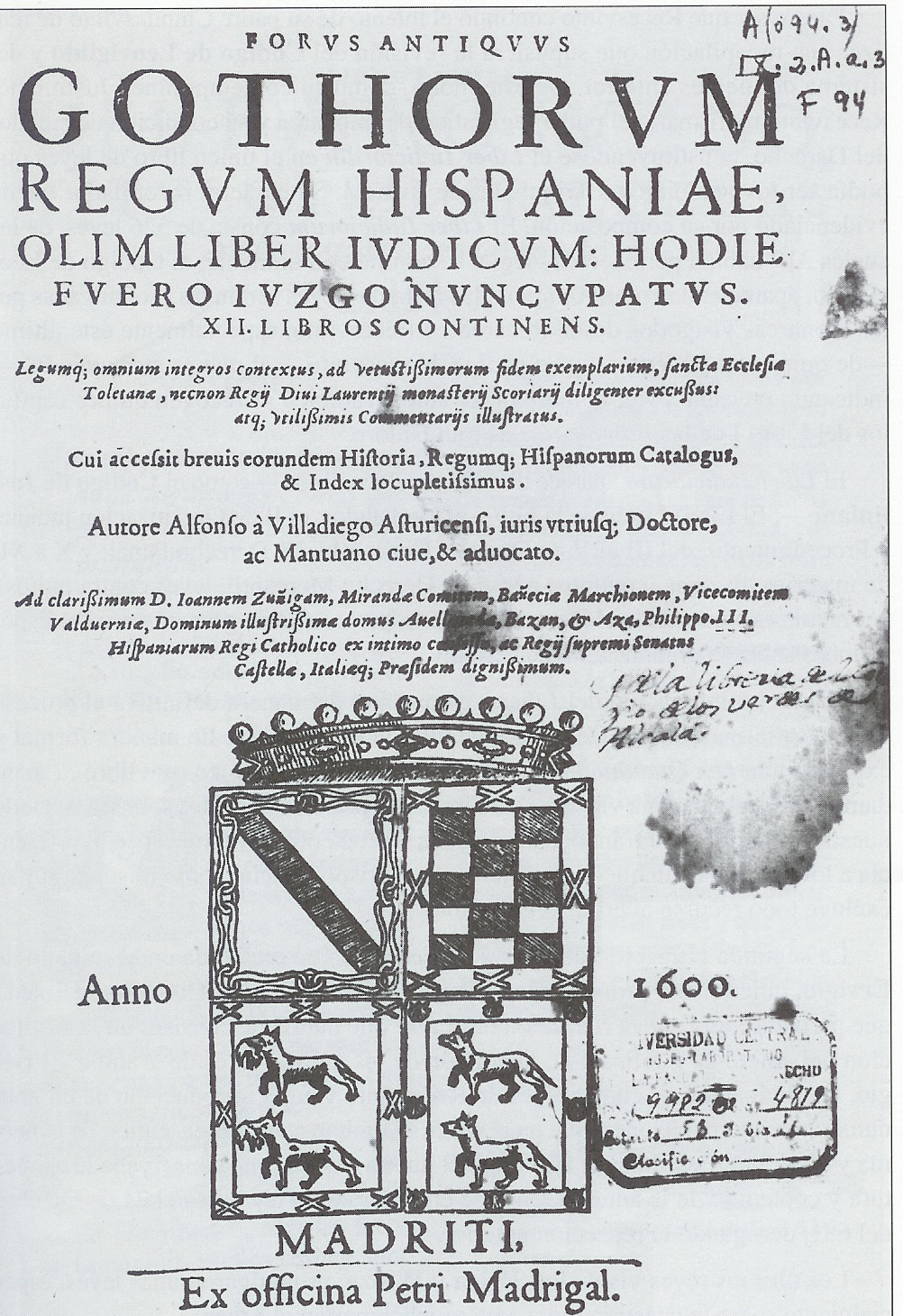
The Visigothic Code (Books I - III)

"II. What the Law Is.

The law is the rival of divinity; the oracle of religion; the source of instruction; the artificer of right; the guardian and promoter of good morals; the rudder of the state; the messenger of justice; the mistress of life; the soul of the body politic (Book I, Title II)."
7th century legislation kicks modern legislation's sorry ass.
"III. It is Permitted to No One to be Ignorant of the Law.

All true science declares that ignorance should be detested. For while it has been written, "he need not understand who desires to act with propriety," it is certain that he who does not wish to know, despises an upright life. Therefore, let no one think that he can do what is unlawful because he was ignorant of the provisions of the laws... for ignorance does not render him innocent, whom guilt has subjected to the penalties of the criminal (Book II, Title I)."

May God bless your barbarian soul, Flavius Recesvintus.
"V. How the Avarice of the King should be Restrained in the Beginning, and How Documents Issued in the Name of the King should be Drawn Up.

...we decree that no king shall, by any means, extort, or cause to be extorted, any documents whatever in acknowledgment of any debt, whereby any person can unjustly, and without his consent, be deprived of his property. And, if by the free will of any one the king should receive a gift, or should openly profit by any transaction, the character of the transaction or contribution should be clearly set forth in the document; by which means either the influence of the prince or the fraud of his accomplice may be readily detected (Book II, Title I)."
What's this? Clearly defined property rights in AD 652? Don't I feel embarrassed.
"VI. Concerning Those who Abandon the King, or the People, or their Country, or who Conduct Themselves with Arrogance.

...we have decreed by this law, which shall prevail through all ages, that whoever, from the time of King Chintilanus of sacred memory, until the second year of our reign, has deserted, or shall desert to the enemy... or even has wished, or shall wish, at any time, to act with criminal intent against the Gothic people; or shall conspire against his country; or, perchance, has attempted at any time to conspire against it, and has been, or shall be captured or detected in the commission of any of these offences... whoever shall be found guilty of all of these crimes, or of any one of them, shall undergo sentence of death; nor shall any leniency be shown him, under any condition, except that his life alone may be spared through the considerate pity of the prince. But this shall not be done until his eyes have been put out, so that he may not see the wrong in which he wickedly took delight, and may henceforth drag out a miserable existence in constant grief and pain (Book II, Title I)."
Someone get the man a copy of Strunk and White! (PS- I edited a lot of that out, too.)
"V. Women Advanced in Years shall not Marry Young Men.

The law of nature is framed in the direct hope of progeny when the nuptial contract is entered into with all due solemnity. For if a marriage takes place between persons who are incompetent, either through age or some personal defect, to properly perform their marital duties, how can their offspring be other than dwarfed or deformed? For that cannot be perfect whose origin is defective. ... For though men have received their name from the fact that they control women by their superior strength; some, in violation of the laws of nature, give the priority to women, when they unite females of advanced age with boys who are little more than children... Therefore, that an end may be put to practices whose results are unfavorable to future generations, we now decree, that, hereafter, women shall always marry men who are older than themselves, and a marriage under other circumstances shall not be valid... (Book III, Title I)."
Sounds like Flavius has been burned before...


(click to better see the lawless Visigothic invasion of enlightened Rome!)

"II. Where a Freeborn Woman Marries a Slave, or her own Freedman.

If a freeborn woman should commit adultery with her own slave, or freedman, or should marry him; as soon as this has been proved, she shall be put to death; and both adulterer and adulteress shall be publicly scourged before the judge and burned. (Book III, Title II)."
Seems reasonable.
"III. Where a Freeborn Woman Marries the Slave of Another, or a Freeborn Man the Female Slave of Another.

If any freeborn woman should marry, or commit adultery with the slave of another, even though he should belong to the king; as soon as this shall come to the knowledge of the judge, he shall order the parties to be separated immediately, that they may suffer the punishment they deserve, to wit: each one a hundred lashes. And if, after this, they should commit the offence a second time, the judge shall order them to be arrested and brought before him, and they shall each receive another hundred lashes. And if they should be guilty for the third time, they shall receive another hundred lashes... (Book III, Title II)."
The difference between her own slave and another's being?...
"I. Where a Freeman carries off a Freewoman by Force, he shall not be permitted to Marry her, if she was a Virgin.

If any freeman should carry off a virgin or widow by violence, and she should be rescued before she has lost her chastity, he who carried her off shall lose half of his property, which shall be given to her."
So attempted rape for the Visigoths was like parking in front of a fire hydrant for us... Those fines'll get ya!
"V. Where any one Carries away by Violence a Woman who was Betrothed to Another.

If any one should carry off a woman betrothed to another, we hereby decree that half of the property of the ravisher shall be given to the girl, and the other half to her betrothed."
I'm glad we call them rapists instead of ravishers- how cool does that sound? I'm a woman and even I'd want to be a ravisher.
"VI. Where a Ravisher is Killed.

If any ravisher should be killed, it shall not be considered criminal homicide, because the act was committed in the defense of chastity."

You Visigoths are just the best.

22 February 2008

The Annals of Tacitus

"In the meantime, Nero recollected that Epicharis was in custody on the information of Volusius Proculus; and, assuming that female flesh and blood must be unequal to the pain, he ordered her to be racked. But neither the lash nor fire, not yet the anger of the torturers, who redoubled their efforts rather than be braved by a woman, broke down her denial of the allegations."
Is a "you go girl" inappropriate here?
"Thus the first day of torment had been defied. On the next, as she was being dragged back in a chair to a repetition of the agony- her dislocated limbs were unable to support her- she fastened the breast-band (which she had stripped from her bosom) in a sort of noose to the canopy of the chair, thrust her neck into it, and, throwing the weight of her body into the effort, squeezed out such feeble breath as remained to her."

How unladylike.
"An emancipated slave and a woman, by shielding, under this dire coercion, men unconnected with her and all but unknown, she had set an example which shone the brighter at a time when persons freeborn and male, Roman knights and senators, untouched by the torture, were betraying each his nearest and dearest."

Well shit, if even Roman men were pussies, what hope is there of me finding a real man here at Yale?
"Paulina replied by assuring him that she too had made death her choice, and she demanded her part in the executioner's stroke. Seneca, not wishing to stand in the way of her glory, and influenced also by his affection, that he might not leave the woman who enjoyed his whole-hearted love exposed to outrage, now said: 'I had shown you the mitigations of life, you prefer the distinction of death: I shall not grudge your setting that example. May the courage of this brave ending be divided equally between us both, but may more of fame attend your own departure!'"
Now if that isn't just the most romantic thing I've ever heard. Take note, gentlemen.
"Before long, the evidence of the same group destroyed the tribune Subrius Flavius. At first he sought to make unlikeness of character a ground of defence: a man of the sword, like himself, would never have shared so desperate an enterprise with unarmed effeminates. Then, as he was pressed more closely, he embraced the glory of confession."
So, he disses his fellow conspirators, admits he hangs out with pansies, and still ends up dead. Well done, Flavius.
"Questioned by Nero as to the motives which had led him so far as to forget his military oath: 'I hated you,' he answered, 'and yet there was not a man in the army truer to you, as long as you deserved to be loved. I began to hate you when you turned into the murderer of your mother and wife- a chariot-driver, an actor, a fire-raiser.'"
Woah... who knew the Chairman of the Party of the Right was a Roman soldier in a past life?