Showing posts with label Sex. Show all posts

30 July 2009

Oriental Trends in the Fall '09 Fashion Season

AKA: How Russians Dress in My Wildest Fantasies.

Design: Karl Lagerfeld
Model: Hanna Rundlof
Ivan IV chic.
Design: Christian Dior
Model: Anja Rubik
Design: Christian Dior
Model: Sigrid Agren
Design: Christian Dior
Model: Heidi Mount

Design: Christian Dior
Model: Erin Heatherton
It's 1920s Moscow -WWI +economic prosperity!

Some comparisons:
Ivan IV & Vasilia Melentyevna
Ivan IV & Beloved Son
Ivan IV at his son's deathbed

21 July 2009

Review of Laurie Manchester's /Holy Fathers, Secular Sons: Clergy, Intelligentsia, and the Modern Self in Revolutionary Russia/ by Christopher Read

From the American Historical Review, Vol 114, No 3 (June 2009).

"At the heart of Manchester's book is an analysis of the small--maybe one percent of the population (p.12)--group of sons of priests (popovichi). Traditionally, scholars have dismissed them as raznochintsy (people of miscellaneous ranks). Instead, Manchester presents them as a relatively clearly defined class with its own ethos and with an influence extending well beyond the church and well beyond its numerical strength."
I've always thought of Raskolnikov as a pretty stereotypical raznochinets.
"In particular, she illustrates many places, including the early Bolshevik Party, where popovichi exerted an influence, despite their small numbers. ... Among such fascinating insights, Manchester notes the way the popovichi identified themselves against the earlier, noble-descended intelligentsia, and how the attempt by Dmitrii Tolstoi to corral popovichi within the clerical estate by refusing to recognize their qualifications as valid for university entrance in fact ensured the values of the seminary would spread to society."
Add this to the long, long list of reasons there's never been a strong libertarian movement in Russia: an influential portion of its intelligentsia were the sons of priests (Catholic liberal embrace of the welfare state, anyone?).
"There are also tantalizing glimpses of unusual attitudes among the popovichi toward sexuality. Aleksei Dmitrievskii failed to consummate his marriage because 'romantic passion' was satisfied by his work. 'Scholarship is the most charming of the women in the world...its embrace...takes care of all the afflictions and misfortunes of life,' he wrote. Note surprisingly, his wife did not agree and left him (p. 185)."
Guess who was the son of a priest? Nikolai Chernyshevsky, socialist-marxist-utilitarian extraordinaire, and author of What is to be done? (so good that Lenin stole the title!). There are some great footnotes in this edition that delve into Chernyshevsky's theories about romantic life; if you've somehow dragged yourself through the beast of a 'novel' you'll understand just as well. Manchester based her book on "a study of 207 identifiable popovichi." It's terrifying how accurate a portrait such a study painted.
"...in Manchester's words, 'popovichi did not repudiate the clerical traditions of the Russian Orthodox Church,' but 'they managed paradoxically to see themselves as leaving the clergy in order to preserve clerical traditions and impose them on secular society.' This, she argues, is 'the very opposite of traditional secularization theory and dechristianization' (p.155)."
Noted.

Painting: Philosophers - Mikhail Nesterov

12 May 2008

Life of the Deified Augustus - Suetonius

In studying for my Roman history final (less than 24 hours from now) I reread Suetonius' account of Augustus, and fell in love with the man all over again. Here's why.

"Others criticize his words and actions, claiming that when the ships were lost in the storm he had cried out that he would conquer even against the will of Neptune and that the next time the circus games were held, he had Neptune's image removed from the festival procession."
Arrogance is sexy, and anyone who tells you otherwise is a liar or a fool. Also, Neptune never really got him back... Augustus 1, Gods 0.
"For he used to compare those who sought a minimal gain at no small risk to someone going fishing with a golden hook, when no catch could bring a profit equal to the loss if the hook were gone."
Translation of genius into simple words. Sounds like someone else I love.
"As for the city itself, which was not decked out in a manner fitting such a great empire... he so improved it that it was with justification that he boasted he had found it a city of brick and left it a city of marble."
Always had a soft spot for effective reformers arising from hopeless eras of suck.
"...he would rather endure some loss of revenue than that the honor of Roman citizenship be made commonplace."
oh-em-gee high citizenship theory. (Note: forward that memo to Caracalla.)
"He sought, too, to revive the ancient manner of dress and once, when he saw at a public meeting a crowd of people dressed in dark clothes, he grew angry and cried out: 'Behold the Romans, lords of the world, the toga'd race!'"
Policy enforcement through snark... I like.
"In sealing official documents, reports and letters, he first used a sphinx, then an image of Alexander the Great, and finally one of himself..."
I reiterate: arrogance is sexy, especially when merited. Subordination of Alexander the Great? May as well besmirch Charles Garland, or Alexander Nevsky, or someone equally influential and bad ass.
"He always shrank from the title 'Master' as an insult and a reproach."
Principate vs dominate, 101. Augustus shows 'em how it's done (forward memo to Diocletian).
"Yet he bore the deaths of his loved ones more readily than their disgrace."
Was ever there a better Roman? Like, really?
"Whenever anyone referred to [Agrippa] or one of the Julias he used to groan and even exclaim: 'Oh, that I had never married and died without children!' The only terms he used for them were his three sores or his three cancers."
No, no there wasn't.
"Not even his friends deny that he committed adultery, suggesting by way of excuse that his motive was not lust but policy, as he sought to find out the plans of his opponents more easily through each man's wife."
Once again, Augustus pioneers a timeless and effective political tactic.
"Mark Antony objected... that he had in front of her husband led the wife of a man of consular rank from the dining-room off into his bedroom, later returning her to the party with burning ears and disheveled hair..."
Balls and pimpery.
"He cultivated an elegant and restrained manner of speaking which avoided the vanity of an artificial style of arrangement, as well as the 'rank odor', as he termed it, 'of far-fetched vocabulary'..."
Crap. Two of my heroes come in conflict.
"When he first began to speak, he ordered some frogs to be silent who happened to be croaking in his grandfather's villa and they say that from that time no frog croaked there."
I'd just like to say here that I love cultures of mythology and am totally okay with attributing ridiculous, implausible stories to those excessively admired and reviled. Respek, yo.

24 February 2008

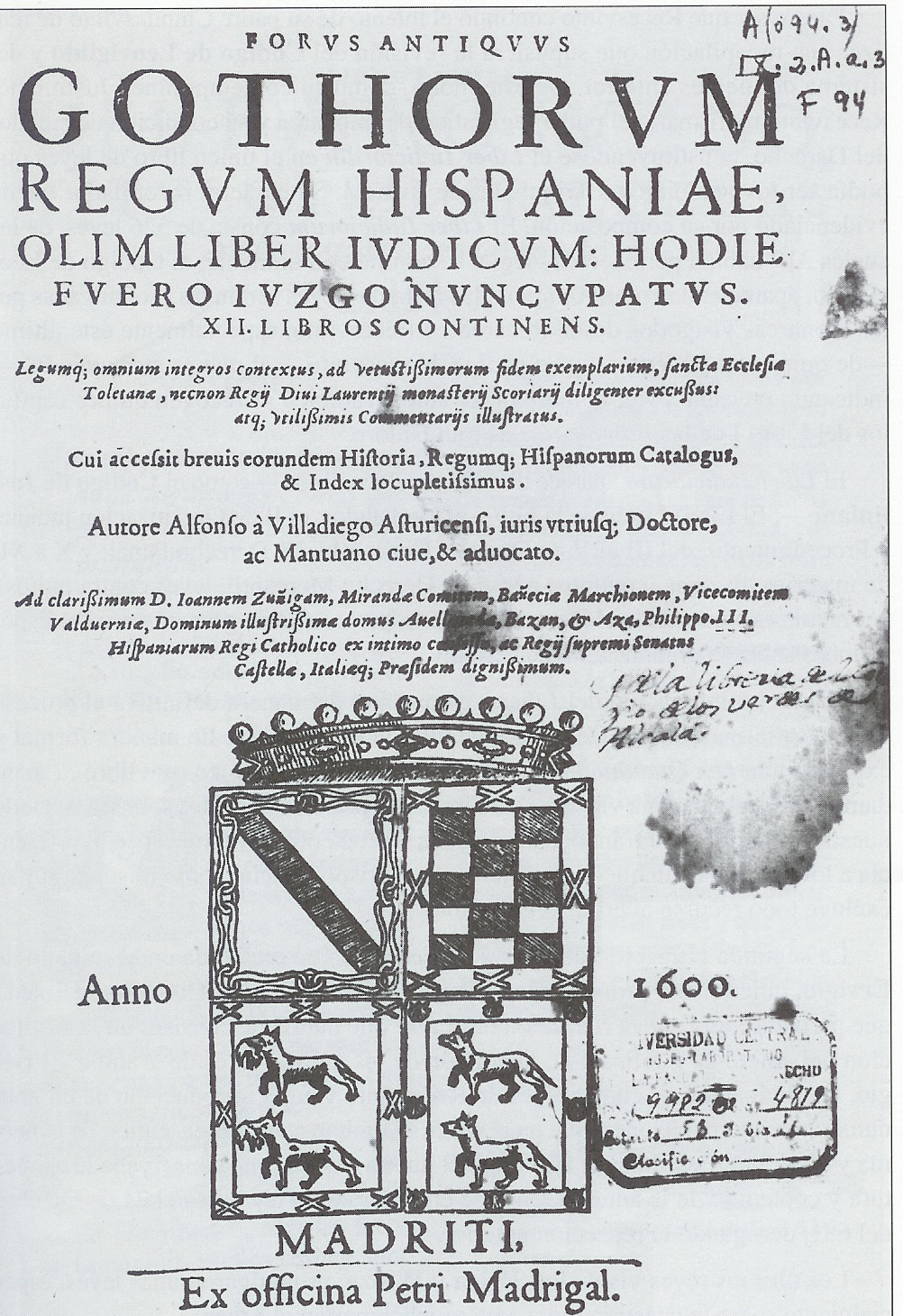
The Visigothic Code (Books I - III)

"II. What the Law Is.

The law is the rival of divinity; the oracle of religion; the source of instruction; the artificer of right; the guardian and promoter of good morals; the rudder of the state; the messenger of justice; the mistress of life; the soul of the body politic (Book I, Title II)."
7th century legislation kicks modern legislation's sorry ass.
"III. It is Permitted to No One to be Ignorant of the Law.

All true science declares that ignorance should be detested. For while it has been written, "he need not understand who desires to act with propriety," it is certain that he who does not wish to know, despises an upright life. Therefore, let no one think that he can do what is unlawful because he was ignorant of the provisions of the laws... for ignorance does not render him innocent, whom guilt has subjected to the penalties of the criminal (Book II, Title I)."

May God bless your barbarian soul, Flavius Recesvintus.
"V. How the Avarice of the King should be Restrained in the Beginning, and How Documents Issued in the Name of the King should be Drawn Up.

...we decree that no king shall, by any means, extort, or cause to be extorted, any documents whatever in acknowledgment of any debt, whereby any person can unjustly, and without his consent, be deprived of his property. And, if by the free will of any one the king should receive a gift, or should openly profit by any transaction, the character of the transaction or contribution should be clearly set forth in the document; by which means either the influence of the prince or the fraud of his accomplice may be readily detected (Book II, Title I)."
What's this? Clearly defined property rights in AD 652? Don't I feel embarrassed.
"VI. Concerning Those who Abandon the King, or the People, or their Country, or who Conduct Themselves with Arrogance.

...we have decreed by this law, which shall prevail through all ages, that whoever, from the time of King Chintilanus of sacred memory, until the second year of our reign, has deserted, or shall desert to the enemy... or even has wished, or shall wish, at any time, to act with criminal intent against the Gothic people; or shall conspire against his country; or, perchance, has attempted at any time to conspire against it, and has been, or shall be captured or detected in the commission of any of these offences... whoever shall be found guilty of all of these crimes, or of any one of them, shall undergo sentence of death; nor shall any leniency be shown him, under any condition, except that his life alone may be spared through the considerate pity of the prince. But this shall not be done until his eyes have been put out, so that he may not see the wrong in which he wickedly took delight, and may henceforth drag out a miserable existence in constant grief and pain (Book II, Title I)."
Someone get the man a copy of Strunk and White! (PS- I edited a lot of that out, too.)
"V. Women Advanced in Years shall not Marry Young Men.

The law of nature is framed in the direct hope of progeny when the nuptial contract is entered into with all due solemnity. For if a marriage takes place between persons who are incompetent, either through age or some personal defect, to properly perform their marital duties, how can their offspring be other than dwarfed or deformed? For that cannot be perfect whose origin is defective. ... For though men have received their name from the fact that they control women by their superior strength; some, in violation of the laws of nature, give the priority to women, when they unite females of advanced age with boys who are little more than children... Therefore, that an end may be put to practices whose results are unfavorable to future generations, we now decree, that, hereafter, women shall always marry men who are older than themselves, and a marriage under other circumstances shall not be valid... (Book III, Title I)."
Sounds like Flavius has been burned before...


(click to better see the lawless Visigothic invasion of enlightened Rome!)

"II. Where a Freeborn Woman Marries a Slave, or her own Freedman.

If a freeborn woman should commit adultery with her own slave, or freedman, or should marry him; as soon as this has been proved, she shall be put to death; and both adulterer and adulteress shall be publicly scourged before the judge and burned. (Book III, Title II)."
Seems reasonable.
"III. Where a Freeborn Woman Marries the Slave of Another, or a Freeborn Man the Female Slave of Another.

If any freeborn woman should marry, or commit adultery with the slave of another, even though he should belong to the king; as soon as this shall come to the knowledge of the judge, he shall order the parties to be separated immediately, that they may suffer the punishment they deserve, to wit: each one a hundred lashes. And if, after this, they should commit the offence a second time, the judge shall order them to be arrested and brought before him, and they shall each receive another hundred lashes. And if they should be guilty for the third time, they shall receive another hundred lashes... (Book III, Title II)."
The difference between her own slave and another's being?...
"I. Where a Freeman carries off a Freewoman by Force, he shall not be permitted to Marry her, if she was a Virgin.

If any freeman should carry off a virgin or widow by violence, and she should be rescued before she has lost her chastity, he who carried her off shall lose half of his property, which shall be given to her."
So attempted rape for the Visigoths was like parking in front of a fire hydrant for us... Those fines'll get ya!
"V. Where any one Carries away by Violence a Woman who was Betrothed to Another.

If any one should carry off a woman betrothed to another, we hereby decree that half of the property of the ravisher shall be given to the girl, and the other half to her betrothed."
I'm glad we call them rapists instead of ravishers- how cool does that sound? I'm a woman and even I'd want to be a ravisher.
"VI. Where a Ravisher is Killed.

If any ravisher should be killed, it shall not be considered criminal homicide, because the act was committed in the defense of chastity."

You Visigoths are just the best.

20 February 2008

Life of Vitellius - Suetonius

"He was a man of integrity and industry but quite notorious for his love of a freedwoman. He would even mix her saliva with honey and rub this into his throat and jaws as a remedy, not secretly or occasionally but quite publicly and every day."
Lucius Vitellius, you old rascal you. No wonder your son was such a classy guy.
"His boyhood and earliest youth he spent on Capri among the favourites of Tiberius- ever after he was branded with the nickname 'tight-bum' and it was thought that it was his physical charms which were the basis and reason for his father's rise."
And in what way could a Roman son better honor his father? You go, Aulus Vitellius.
"And when he arrived at the fields in which the fighting had taken place and some of those with him expressed their horror at the stench of the corpses, he made so bold as to offer them reassurance with the following repulsive comment: 'The smell of a dead enemy is excellent- and even better in civil war.'"
Weren't you just made emperor like five minutes ago? Rejoicing at the sight of dead Romans might not be the best way to stabilize your support, amice.
"Above all, however, he was addicted to luxury and to cruelty, always having at least three feasts, sometimes four in a day- breakfast, lunch, dinner, and a drinking party- and easily finding capacity for it all through regular vomiting.
Clearly a cry for help! If only he'd been able to write in to PostSecret.
"As for the money lenders... he spared scarcely any... It was one of these whom he committed to punishment, just as the man had come to pay his respects, then called him back. Everyone was praising this act of mercy, when he gave orders that the execution should take place in his presence, for he 'wanted his eyes to have a feast'."
Bitch with a capital B.
"When he found that it was quite deserted and those who were with him were slipping away, he put on a belt full of gold coins and took refuge in the porter's lodge, having chained up a dog at the entrance and blocked the door with a bed and mattress."
At least he went out with dignity... oh, wait...

"...with his hands tied behind his back, a noose around his neck, and his clothes torn, he was dragged half-naked into the Forum and, amid gross abuse, physical and verbal, along the whole length of the Sacred Way, his head pulled back by the hair, in the way of condemned criminals, and even his chin held up with the point of a sword, so that he should let his face be seen and not lower it. Some people threw dung and filth, calling him an arsonist and a glutton. Some of the common people even criticized his bodily defects, for he was unusually tall, his face was generally very red because of his drinking, and his belly distended. ... Finally, he was butchered on the Gemonian steps with the smallest incisions and, when he was dead, he was dragged from there with a hook to the Tiber."
A noble end to a noble reign. By the way, this is a whole eight months after he was first declared Emperor.