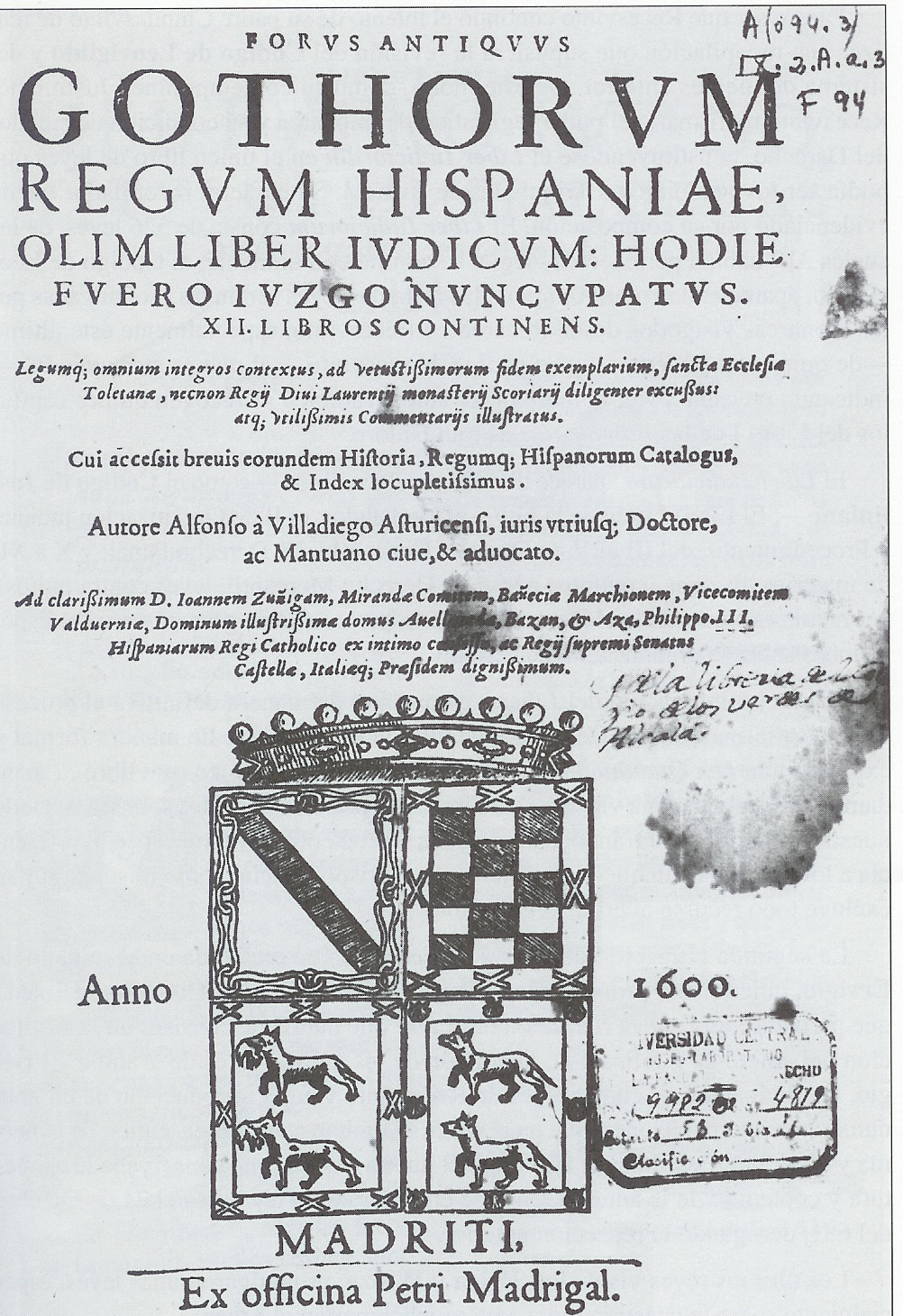
"II. What the Law Is.
The law is the rival of divinity; the oracle of religion; the source of instruction; the artificer of right; the guardian and promoter of good morals; the rudder of the state; the messenger of justice; the mistress of life; the soul of the body politic (Book I, Title II)."
7th century legislation kicks modern legislation's sorry ass.
"III. It is Permitted to No One to be Ignorant of the Law.
All true science declares that ignorance should be detested. For while it has been written, "he need not understand who desires to act with propriety," it is certain that he who does not wish to know, despises an upright life. Therefore, let no one think that he can do what is unlawful because he was ignorant of the provisions of the laws... for ignorance does not render him innocent, whom guilt has subjected to the penalties of the criminal (Book II, Title I)."
May God bless your barbarian soul, Flavius Recesvintus.
"V. How the Avarice of the King should be Restrained in the Beginning, and How Documents Issued in the Name of the King should be Drawn Up.
...we decree that no king shall, by any means, extort, or cause to be extorted, any documents whatever in acknowledgment of any debt, whereby any person can unjustly, and without his consent, be deprived of his property. And, if by the free will of any one the king should receive a gift, or should openly profit by any transaction, the character of the transaction or contribution should be clearly set forth in the document; by which means either the influence of the prince or the fraud of his accomplice may be readily detected (Book II, Title I)."
What's this? Clearly defined property rights in AD 652? Don't I feel embarrassed.
"VI. Concerning Those who Abandon the King, or the People, or their Country, or who Conduct Themselves with Arrogance.
...we have decreed by this law, which shall prevail through all ages, that whoever, from the time of King Chintilanus of sacred memory, until the second year of our reign, has deserted, or shall desert to the enemy... or even has wished, or shall wish, at any time, to act with criminal intent against the Gothic people; or shall conspire against his country; or, perchance, has attempted at any time to conspire against it, and has been, or shall be captured or detected in the commission of any of these offences... whoever shall be found guilty of all of these crimes, or of any one of them, shall undergo sentence of death; nor shall any leniency be shown him, under any condition, except that his life alone may be spared through the considerate pity of the prince. But this shall not be done until his eyes have been put out, so that he may not see the wrong in which he wickedly took delight, and may henceforth drag out a miserable existence in constant grief and pain (Book II, Title I)."
Someone get the man a copy of Strunk and White! (PS- I edited a lot of that out, too.)
"V. Women Advanced in Years shall not Marry Young Men.
The law of nature is framed in the direct hope of progeny when the nuptial contract is entered into with all due solemnity. For if a marriage takes place between persons who are incompetent, either through age or some personal defect, to properly perform their marital duties, how can their offspring be other than dwarfed or deformed? For that cannot be perfect whose origin is defective. ... For though men have received their name from the fact that they control women by their superior strength; some, in violation of the laws of nature, give the priority to women, when they unite females of advanced age with boys who are little more than children... Therefore, that an end may be put to practices whose results are unfavorable to future generations, we now decree, that, hereafter, women shall always marry men who are older than themselves, and a marriage under other circumstances shall not be valid... (Book III, Title I)."
Sounds like Flavius has been burned before...

(click to better see the lawless Visigothic invasion of enlightened Rome!)
"II. Where a Freeborn Woman Marries a Slave, or her own Freedman.
If a freeborn woman should commit adultery with her own slave, or freedman, or should marry him; as soon as this has been proved, she shall be put to death; and both adulterer and adulteress shall be publicly scourged before the judge and burned. (Book III, Title II)."
Seems reasonable.
"III. Where a Freeborn Woman Marries the Slave of Another, or a Freeborn Man the Female Slave of Another.
If any freeborn woman should marry, or commit adultery with the slave of another, even though he should belong to the king; as soon as this shall come to the knowledge of the judge, he shall order the parties to be separated immediately, that they may suffer the punishment they deserve, to wit: each one a hundred lashes. And if, after this, they should commit the offence a second time, the judge shall order them to be arrested and brought before him, and they shall each receive another hundred lashes. And if they should be guilty for the third time, they shall receive another hundred lashes... (Book III, Title II)."
The difference between her own slave and another's being?...
"I. Where a Freeman carries off a Freewoman by Force, he shall not be permitted to Marry her, if she was a Virgin.
If any freeman should carry off a virgin or widow by violence, and she should be rescued before she has lost her chastity, he who carried her off shall lose half of his property, which shall be given to her."
So attempted rape for the Visigoths was like parking in front of a fire hydrant for us... Those fines'll get ya!
"V. Where any one Carries away by Violence a Woman who was Betrothed to Another.
If any one should carry off a woman betrothed to another, we hereby decree that half of the property of the ravisher shall be given to the girl, and the other half to her betrothed."
I'm glad we call them rapists instead of ravishers- how cool does that sound? I'm a woman and even I'd want to be a ravisher.
"VI. Where a Ravisher is Killed.
If any ravisher should be killed, it shall not be considered criminal homicide, because the act was committed in the defense of chastity."
You Visigoths are just the best.

"For the young women, however, the Devil had prepared a mad heifer. This was an unusual animal, but it was chosen that their sex might be matched with that of the beast. So they were stripped naked, placed in nets and thus brought out into the arena. Even the crowd was horrified when they saw that one was a delicate young girl and teh other was a woman fresh from childbirth with the milk still dripping from her breasts. And so they were brought back again and dressed in unbelted tunics."