Showing posts with label Christianity. Show all posts

16 February 2010

The Great Persecution and its Consequences - Henry Chadwick

The Diocletianic Persecution lasted from AD 303 - 313. In a series of edicts released between AD 303 and 304, Diocletian ordered the destruction of all Christian churches, the confiscation of all Bibles, liturgical books, and sacred vessels, forbade the gathering of Christians to worship, ordered the arrest of all clergy, and made refusal to sacrifice to the pagan gods punishable by death.

The worst legacy of the persecution was once again schism. As in modern times the Christians differed among themselves about the point at which resistance to the State must be absolute. In the East sacrifice was regarded as apostasy, not the surrender of sacred books and church plate. But in the West opinion was divided, passion ran high, and in consequence, although persecution was briefer and left most western provinces unaffected, the scars were more serious than in the East.

...in Numidia especially, the surrender of the scriptures or indeed of any books which the police were ready to accept as such (one bishop handed in medical treatises) was regarded as apostasy. To think otherwise was to derogate from the glory of those who had died rather than surrender, since it implied that they had been overdoing it [emphasis mine].
Have a contemplative first week of Lent (Clean Week!), ladies and gents.

21 July 2009

Review of Laurie Manchester's /Holy Fathers, Secular Sons: Clergy, Intelligentsia, and the Modern Self in Revolutionary Russia/ by Christopher Read

From the American Historical Review, Vol 114, No 3 (June 2009).

"At the heart of Manchester's book is an analysis of the small--maybe one percent of the population (p.12)--group of sons of priests (popovichi). Traditionally, scholars have dismissed them as raznochintsy (people of miscellaneous ranks). Instead, Manchester presents them as a relatively clearly defined class with its own ethos and with an influence extending well beyond the church and well beyond its numerical strength."
I've always thought of Raskolnikov as a pretty stereotypical raznochinets.
"In particular, she illustrates many places, including the early Bolshevik Party, where popovichi exerted an influence, despite their small numbers. ... Among such fascinating insights, Manchester notes the way the popovichi identified themselves against the earlier, noble-descended intelligentsia, and how the attempt by Dmitrii Tolstoi to corral popovichi within the clerical estate by refusing to recognize their qualifications as valid for university entrance in fact ensured the values of the seminary would spread to society."
Add this to the long, long list of reasons there's never been a strong libertarian movement in Russia: an influential portion of its intelligentsia were the sons of priests (Catholic liberal embrace of the welfare state, anyone?).
"There are also tantalizing glimpses of unusual attitudes among the popovichi toward sexuality. Aleksei Dmitrievskii failed to consummate his marriage because 'romantic passion' was satisfied by his work. 'Scholarship is the most charming of the women in the world...its embrace...takes care of all the afflictions and misfortunes of life,' he wrote. Note surprisingly, his wife did not agree and left him (p. 185)."
Guess who was the son of a priest? Nikolai Chernyshevsky, socialist-marxist-utilitarian extraordinaire, and author of What is to be done? (so good that Lenin stole the title!). There are some great footnotes in this edition that delve into Chernyshevsky's theories about romantic life; if you've somehow dragged yourself through the beast of a 'novel' you'll understand just as well. Manchester based her book on "a study of 207 identifiable popovichi." It's terrifying how accurate a portrait such a study painted.
"...in Manchester's words, 'popovichi did not repudiate the clerical traditions of the Russian Orthodox Church,' but 'they managed paradoxically to see themselves as leaving the clergy in order to preserve clerical traditions and impose them on secular society.' This, she argues, is 'the very opposite of traditional secularization theory and dechristianization' (p.155)."
Noted.

Painting: Philosophers - Mikhail Nesterov

13 July 2009

Prague Tales - Jan Neruda

Picked up a copy of this at the DC Public Library for $2 a few weeks ago- more than worth it. All excerpts were published between 1867 and 1876.
"'But why didn't he write out his whole name? What's his first name, Viktor, Volfgang?'
'Well, it's Václav, but he doesn't like it. He says that every time he sees a church procession he wants to get re-baptized.'"
Typical Czech-German pandering.
"'...I don't think I've ever seen a decent, moderately long sentence from any of you. ... It's also quite obvious that you don't even know German properly, and I'll tell you why: because you jabber away in Czech all day! Therefore, with the power invested in my office as Director, I hereby forbid the speaking of Czech in the office, and as your friend and your superior I suggest that you speak only German outside the office as well.'"
Wait, they have the "notes of a neurotic 19th century bureaucrat" genre outside Russia, too?
"Conversations in Czech ceased. Only two very close friends would utter a word in Czech out in the corridor or in the archives. They almost seemed like surreptitious snuff-takers. I keep speaking Czech--and loudly at that. Everyone avoids me."
Tobacco stigma in 1860s Mala Strana? Jeez.
"It is a well-known historical fact that gods arise directly from their people. Jehovah was a gloomy, cruel, angry, vengeful, and bloodthirsty god, just like the entire Jewish nation. The Hellenic gods were elegant and witty, beautiful and joyful, just like the Greeks themselves. The Slavic gods--I'm sorry, but we Slavs lack a vivid enough imagination to create either great states or well-defined gods. Despite the best efforts of folklorists such as Erben and Kostomarov, our erstwhile gods are only an obscure, rag-tag group of divinities with no clear, well-defined characteristics."
Kinda true, actually.
"Of course the priest from St. Nicholas' and his assistants were late, as was the custom at the funeral of any important person so that no one would say Mr. Velš was being hurried on his way."
That's what we call a win-win cultural development.

14 April 2008

A Return

Sorry for the hiatus- more regular posting will resume shortly. In the meantime, here's some stuff that's been floating around in my brain:

“When enough people share a delusion, it loses its status as a psychosis and gets a religious tax exemption instead.” - Ronald de Sousa, Why Think? Evolution and the Rational Mind

"
I have always said that the reason why philosophers are so disliked on university campuses is that we are brighter than anyone else and have trouble concealing the fact." - Michael Ruse, Literary Review of Canada

"As a phenomenon, I am in his debt because it turns out that - like Shakespeare and Coca-Cola - he is a brand, with brand values we respond to." - Gyles Brandreth on Oscar Wilde in the Times Online

"Pop sociologists would have us believe that the distinction between spirituality and religion arose in American culture about the same time as the musical Hair. Actually, the concept of spirituality (individualistic, mystical, pluralist) as distinct from religion (institutional, creedal, orthodox) originated in the 1830s with the flowering of Emerson's distinctive variety of Romanticism." - Michael Robertson in The Chronicle Review

"Er aber ging hin in die Wüste eine Tagereise und kam hinein und setzte sich unter einen Wacholder und bat, daß seine Seele stürbe, und sprach: Es ist genug, so nimm nun, HERR, meine Seele; ich bin nicht besser denn meine Väter." - 1 Kings 19:4

28 February 2008

The Martyrdom of Saints Perpetua and Felicitas

"For these too will one day become ancient and needful for the ages to come, even though in our own day they may enjoy less prestige because of the prior claim of antiquity."
This was written around AD 203, roughly.
"Thus no one of weak or superficial faith may think that supernatural grace was present only among men of ancient times, either in the grace of martyrdom or of visions, for God always achieves what he promises, as a witness to the non-believer and a blessing to the faithful."
Trads beware.
"She had been pregnant when she was arrested, and was now in her eighth month. As the day of the spectacle drew near she was very distressed that her martyrdom would be postponed because of her pregnancy; for it is against the law for women with child to be executed. ... And so, two days before the contest, they [the Christians in prison with her] poured forth a prayer to the Lord in one torrent of common grief. And immediately after their prayer the birth pains came upon her. ... And she gave birth to a girl."
Is that the right attitude to have towards martyrdom? Or motherhood? Or anything?
"For whenever they would discuss among themselves their desire for martyrdom, Saturninus indeed insisted that he wanted to be exposed to all the different beasts, that his crown might be all the more glorious."
Can a Catholic please explain this to me? This seems fundamentally wrong, or at least, like... impious.
"For the young women, however, the Devil had prepared a mad heifer. This was an unusual animal, but it was chosen that their sex might be matched with that of the beast. So they were stripped naked, placed in nets and thus brought out into the arena. Even the crowd was horrified when they saw that one was a delicate young girl and teh other was a woman fresh from childbirth with the milk still dripping from her breasts. And so they were brought back again and dressed in unbelted tunics."
What were they thinking, sending them to face the beast without their tunics! Gosh, how uncultured.
"First the heifer tossed Perpetua and she fell on her back. Then sitting up she pulled down the tunic that was ripped along the side so that it covered her thighs, thinking more of her modesty than of her pain. Next she asked for a pin to fasten her untidy hair: for it was not right that a martyr should die with her hair in disorder, lest she might seem to be mourning in her hour of triumph."
This is starting to sound like something out of a Mel Brooks movie.

26 February 2008

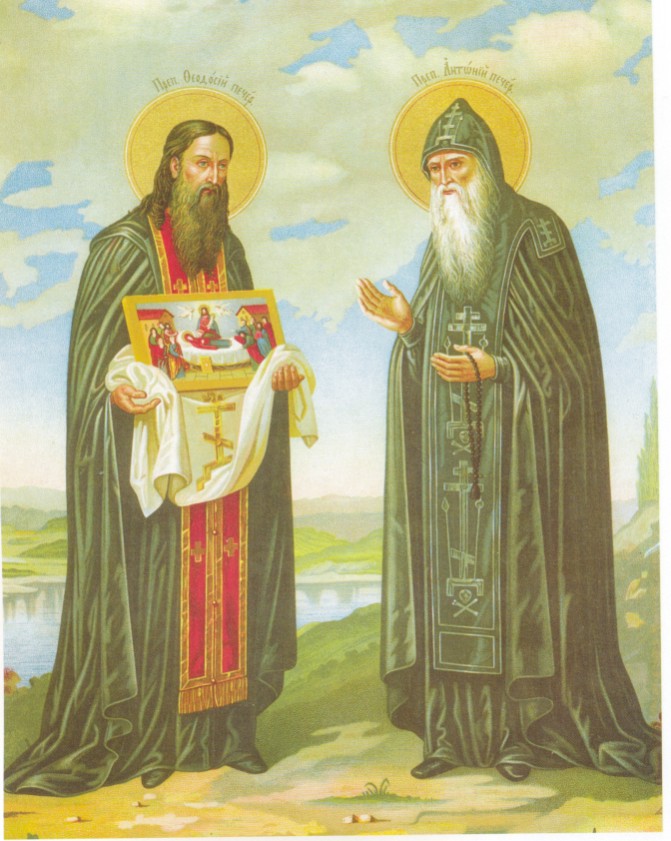
Life of Our Blessed Father Theodosius

I love all of the Russian Saints' Lives, but this one is particularly dear to me. I'm going to make a pilgrimage to the Monastery of the Caves (Киево-Печерская лавра) one day.
"He did not draw near to the children playing, as is the custom of youth, but disdained their games. His clothing was poor and patched. For this reason his parents many times tried to force him to dress in clean clothing and to go out and play with the children; but he did not obey them in this, but willed even more to be like one of the poor."
oh-em-gee he recognizes that the judgment of his parents is fallible no waiiii.
"Thenceforth he began to be more persevering in his works, as when he would go away with the serfs to the country and act with all manner of humility. But his mother would hinder him, not wishing him to do such things..."
Wait what? His mother doesn't have his best interest in mind?
"She would often get angry at him and beat him; for she was strong and solid in body as a man, and, indeed, if someone could not see her but only hear her conversing, he would begin to think she was a man."
Slavic women for the win.
"Having gotten up during the night and not letting anyone know, secretly went out of the house, not taking with him anything except the clothing he was wearing, and even that was poor. And in that manner he went away behind the pilgrims. ... After three days his mother, having found out... rode hurriedly a long way, and, catching up with them, took Theodosius. And from rage and anger his mother grasped him by the hair and threw him upon the ground and kicked him with her feet. And, having severely reproached the pilgrims, she returned home leading her son tied like a villain."
A few months prior to this his father died. See what happens in the absence of a strong father figure?
"Being gripped by such great anger, even when they had arrived home, she beat him until she could no longer. And after this she led him to a room, tied him up, and locked the door as she left. The divine youth, however, accepted all these things with joy, and praying to God, gave thanks."
He's thirteen here, by the way.
"She... began with entreaty to persuade him not to run away from her, for she loved him very much more than her other children and for this reason could not bear living without him. And when he promised that he would not leave her, she removed the irons from his legs."
Love. Right.
"Having again seen him baking sacramental wafers and becoming blackened from the fire in the oven, she deplored it greatly. And from that time she began again to scold him, sometimes with caresses, sometimes with terror, and at other times beating him to make him forsake such work."
When you're beating your eldest son for baking the fucking Eucharist, the problem is probably with you.
"The blessed Theodosius, having gone to one of the smithies, ordered him to forge an iron chain; and taking it, he girded his loins with it and went about thus. And although the iron was tight and gnawed into his body, he remained as though his body were suffering no injury from it. ... And so while he was dressing himself in the clean garment, being simple in mind and not minding her presence, she was carefully watching, wishing to see more clearly; and lo, she saw on his undergarment blood, which came from the gnawing of the iron. Having become excited with anger against him and having risen with rage and torn apart the undergarment on him, beating him, she removed the iron from his loins."
Is it manly to take this many beatings from your mother?
"Then the elder went out and said to her: 'I have pleaded with him much, but he does not deign to come out to thee.' Thenceforth she began not to speak to the elder with humility, but cried out with anger: 'So! Thou art the monk who has taken my son and hidden him in a cave and thou dost not want to show him to me. Bring my son out to me, monk, so that I may see him; for if I do not see him, I cannot bear to remain alive. ... For lo, I will kill myself before the doors of this cave if thou dost not show him to me.'"
Shut the fuck uuup. Why didn't you let her, Antonius? Why?
"But the blessed one said to her: 'Then if thou wishest to see me every day, come to this city, and having entered one of the nunneries, take the veil. ... If thou dost not do this, then I tell thee the truth: from this time forth thou wilt not see my face.'"
Finally, Theo grows a pair!
"The two younger princes started fighting with their elder brother, the religious Iziaslav, and forced him out of the capital city of Kiev. When the two brothers entered Kiev they sent for venerable Abbot Theodosius... Abbot Theodosius, who knew of the injustice accorded to Iziaslav, and being inspired by the Holy Ghost, gave an answer according to the Holy Spirit. 'I shall not go to the feast of Jezebel and taste the fruit of murder covered with blood.'"
So the Russians wrote a Bildungsroman eight centuries before the Germans figured it out... of course, in the Russian 11th century version, the protagonist attains badassery instead of self-fulfillment. I think it's pretty clear which is the superior genre (not that this is fiction).

21 February 2008

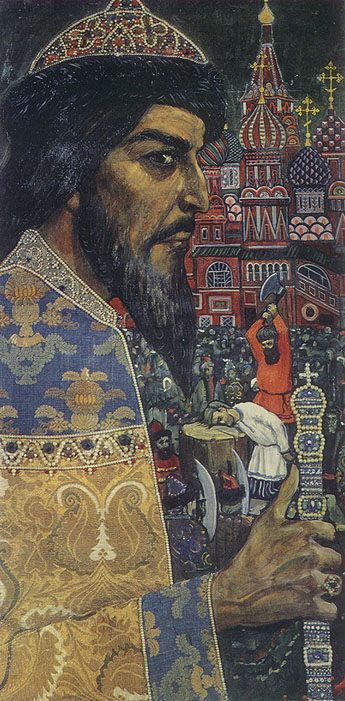
First Epistle of Prince Andrey Kurbsky

Written to the Tsar and Grand Prince of Moscow [Ivan IV] in consequence of his fierce prosecution:
"If you have understanding, may you understand this with your leprous conscience- such a conscience as cannot be found even amongst the godless peoples."
Just so everyone's clear, this is Ivan the Terrible this man's writing to. Ivan... the Terrible.
"But I cannot now recount the various misfortunes at your hands which have beset me owing to their multitude and since I am filled with the grief of my soul."
What a whiny little bitch.
"Think not that concerning these things I will remain silent before you; to my end I will incessantly cry out with tears against you to the everlasting Trinity, in which I believe; and I will call to my aid the Mother of the Lord of the Cherubims, my hope and protectress, Our Lady, the Mother of God, and all the Saints, the elect of God, and my master and forefather, Prince Fedor Rostislavich, whose corpse remains incorruptible, preserved throughout the ages, and emits from the grave sweet odours, sweeter than aromatics, and, by the grace of the Holy Ghost, pours forth miraculous healing streams, as you, O tsar, know well."
Ah, pious you may be, Prince Kurbsky, but can you overcome the sin wrought on your soul by the length of this one ungodly sentence?
"I have heard from sacred writings that a destroyer will be sent by the devil against the human race, a destroyer conceived in fornication, the Antichrist, hostile to God; and now I have seen a counsellor, known to all, who was born in adultery and who today whispers falsehoods in the ears of the tsar and sheds Christian blood like water and has already destroyed the strong and noble in Israel, as one in agreement with the Antichrist in deed."
Apparently not.
"...we who have been banished and driven out by you without justice from the land cry out day and night to God, however much in pride you may boast in this temporal, fleeting life, devising vessels of torture against the Christian race, yea, and abusing and trampling on the Angelic Form, with the approbation of your flatterers and comrades of the table, your quarrelsome boyars, the destroyers of your soul and body, who urge you on to aphrodisiacal deeds and, together with their children, act more viciously than the priests of Cronus."
Little known historical fact: emo dates back to the Riurikid dynasty.